Global Emotions Project
In January 2025 we started asking our own global community what they were afraid of. While this approach generated hundreds of responses, it was when we started asking artists visiting musicto.com the same question, that responses grew into the thousands.
That was the lightbulb moment which lead to the questions: What if we ask artists more questions about how they feel? What if we use Plutchik’s wheel of emotions and build a picture of how creatives across the globe are feeling over time?
Outcome
A softening in negative feelings about strangers
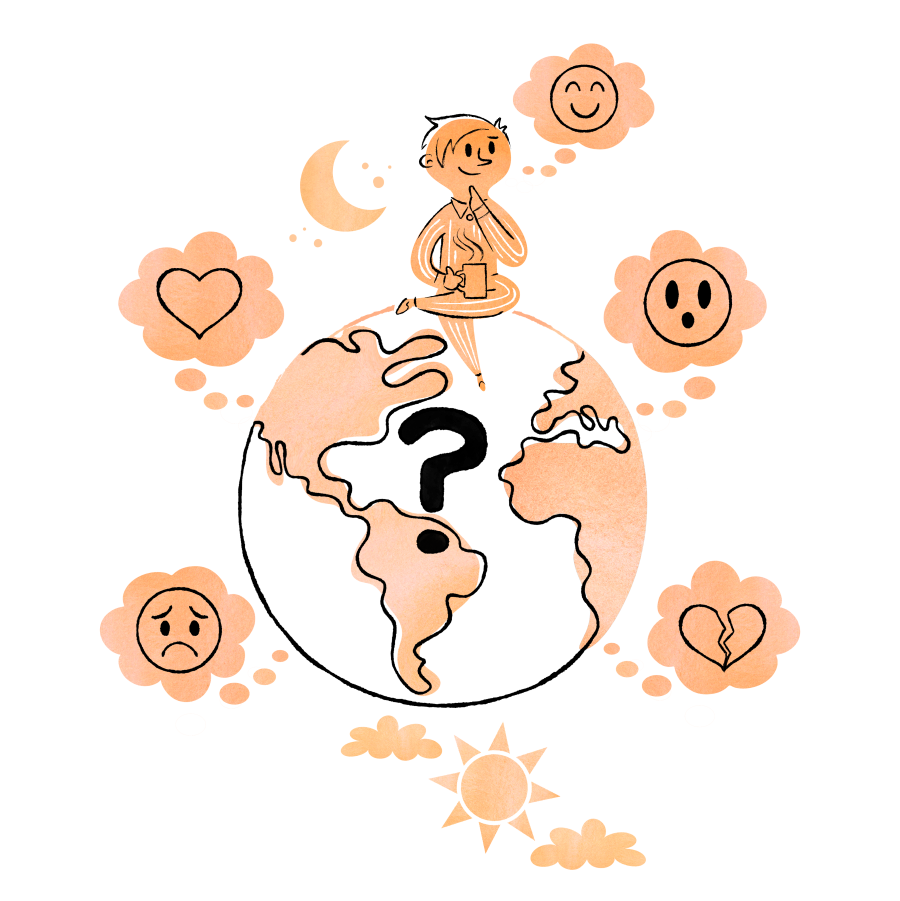
It doesn’t matter whether the answer comes from Lagos, Los Angeles, or Manila – the stories generated show we have a surprisingly large amount in common. The differences across cultures and generations are real, but underneath them, people share the same feelings about what it is to be human.
Where musicto.com works at the level of relationships, one connection at a time, the Global Emotions Project works at the level of information, changing the narrative around othering at a scale no single friendship can reach.

How it works
The project asks one emotional question at a time, each drawn from Plutchik’s wheel. We started with fear. We are asking about surprise now. Trust is next.
Artists submitting their music to the musicto.com community are presented with the question after they have submitted their track through the website. We lead with the question and ask which generation they belong to and which continent they live on. Currently about 55% of artists who submit tracks answer the question.
Results to date
Our first question – What are you afraid of, and why? – gathered over 3,500 responses from seven continents and six generations, in more than 20 languages. The full analysis is available as a white paper you can download here. Its clearest finding is: the same fears surfaced in every continent and every generation.
We are currently asking – When was the last time something truly surprised you, and what did it feel like? That question has drawn 2,900 responses so far, against a target of 5,000, and a preliminary analysis of the first 1,500 is available to download here. Once we reach 5,000 responses, we move on to disgust.

What funding accelerates
The major challenge to the Global Emotions Project is how we get the stories and insights out into the world. AI has helped generate high-level analysis, and our Insights from Others Substack can deliver the stories in text format, but it feels like we have this “connectivity-gold” locked up in spreadsheets and boring to read white papers.
We’re looking to collaborate with a partner to help us free these stories and present them in a way that will move through social platforms, resonating and connecting with millions of people across the world. We have the creative agency that knows how to do this efficiently and effectively. What we lack is the funding.
What’s even cooler is – imagine we run this program not just for years, but for decades, and even centuries. Every 6 years we revisit the same question. Wouldn’t you be interested to see how the global creative mindset is feeling and how it changes over time? How would these stories change – what would we learn about generational and cultural shifts – what would it reveal about the changing nature of what it means to be human?
If you’re as fascinated with this idea as we are – we’d love to chat with you.